Wednesday, 19 November 2014

Suicide - Too Punk for the Punks

TOWARDS the end of the 60's and early 70's foundations were being laid and seeds planted by bands like The Stooges and New York Dolls for what would eventually become known as punk rock.  Few bands of this era were as influential as Suicide. The very name is unnerving, before a note has been played or a word uttered it forces the audience onto their heels and places them in a state of unease.  Then reality strikes - the street thug leather, the motorcycle chain, their overtly anti-war lyrics ("America, America is killing its youth" - Ghost Rider) and confrontational onstage antics.  All aligned with the palpable air of violence that pervaded their music. Everything they did went against the grain, they once famously said: "People wanted fantasy, we gave them the streets".

In other words, they weren't going to sing about the idyllic side of life but the gritty harsh realities - death, despair, poverty and violence.  It is human nature to be responsive to violence, we are drawn to it in sports and shocked by it in life, it undeniably provokes reaction.  In musical terms, the widespread fascination with punk rock probably best illustrates this point.  Whether you are a fan of punk or not, you will have formed an opinion based on seeing Johnny Rotten swearing on TV, Iggy Pop cut himself with broken glass onstage or footage of violent concerts with spitting fans (and let's not even mention the grotesquery of GG Allin). 
  
The stooges had that air of menace, New York Dolls commanded respect, later on a lot of the pivotal bands in the hardcore rock scene (who attempted to push punk rock a step further) channeled anger and discontent.  Suicide lived it, they had danger dripping from their blood-stained leather jackets. They were the first band to use the term punk, distributing flyers for a show called 'Punk Music Mass', prior to that only music journalist Lester Bangs had used the word in an article about The Stooges in 1969. Alan Vega would take to the stage wild eyed, seeking gratification in goading the audience before him.  He wanted to incite violence or at least provoke some kind of reaction.  In the early days the audience were more than happy to oblige.  
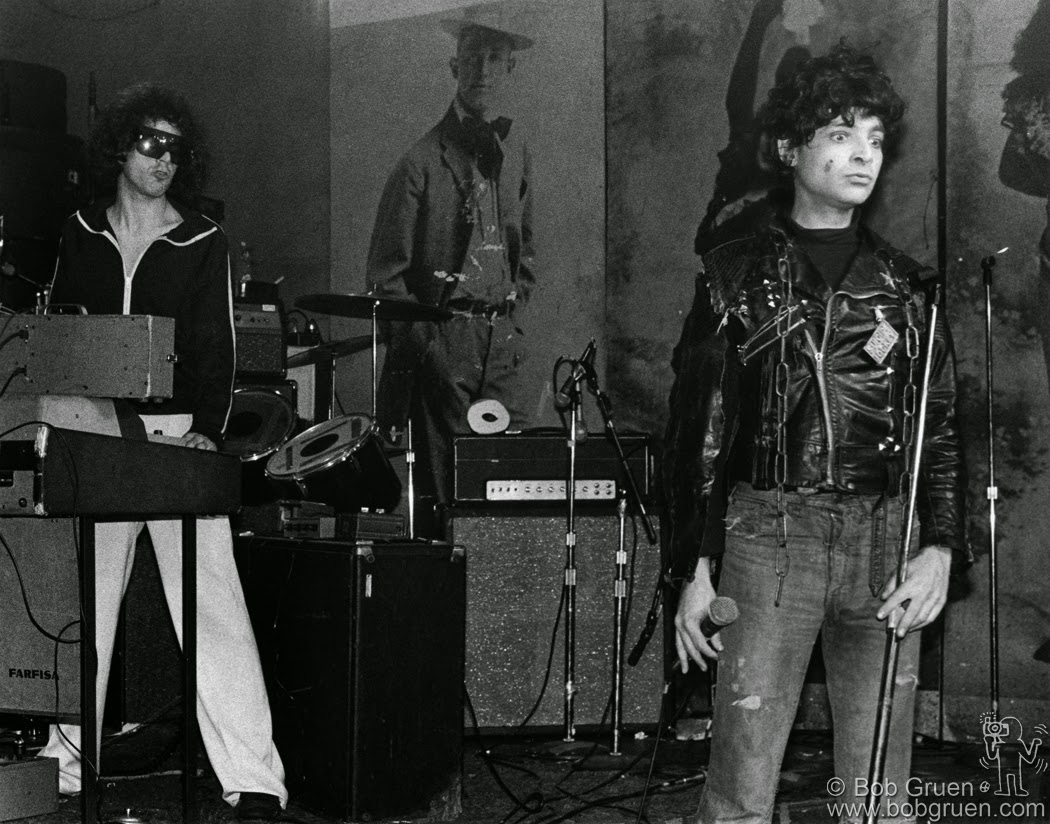


"They were riots. I used to jump in the audience and antagonise people. The sound was already antagonising them. We chose not to be entertainers at that time. People came off the street to be entertained by our band and forget their problems for a while but when they came to a Suicide show they got the street right back in their faces and that probably antagonised everybody.  All kinds of shit went on stage, plus the way I sang, the way I danced, just attacking the audience physically." - Alan Vega.


They were abhorred by traditional punk fans who expected and demanded the holy trinity of rock music which was drums, bass and guitar.  An acrimonious approach to live shows stemmed from Vega's introduction to The Stooges.  He has pinpointed that night as a life-affirming moment, which ultimately triggered his decision to become a performer.  He observed Iggy confound and captivate the audience before him in equal measure.  


"It was when I saw Iggy Pop, that's what did it for me.  That
changed my life pretty much...I knew nothing about the Stooges, and it turns out the next night they were opening up for the MC5... 1968 or 1969 in the New York State Pavilion Building...I knew nothing about Iggy, I had no idea what it was all about.  I went basically there to see the band and to see Ronnie Asheton play guitar.  And there was Iggy! And that blew me away! It was just like, I can't be the same anymore, ya know what I mean? And the last place I ever thought I'd be spending my life was onstage, ya know what I mean?"                       
Alan Vega.


It broke the walls down for Vega, inspired by Iggy's maniacal performance he realised musicians didn't have to conform to a set of rules.  The whole concept of drums and guitars, audience and stage could be manipulated to create something which would be the antithesis to conventional rock music.  A sculptor at the time Vega felt music could be a vehicle in which to express his full artistic capabilities.


"He broke down the audience/stage thing.  He broke it down
completely!  It was like an environmental piece of art.  He changed
the whole thing, right then and there, that night.  And I realised, if I'm
gonna be a true artist to myself, I just have to follow in this new
direction...Life is a gamble.  And I took a chance, man."  
Alan Vega on Iggy Pop.


Vega didn't fit the mould, he wore his hair short at a time it was considered uncool and was often decked out in flamboyant stage attire.  He regularly brandished a motorcycle drive chain onstage and would wrap it around the venue doors to stop people from leaving. Fans were oiled to the eyeballs awaiting their favourite punk bands and Suicide would enter the room as support for the main act.  The punks watching The Sex Pistols and The Clash couldn't assimilate the music of Suicide. 


"We weren’t giving them any basis for what they knew. We were kicking their legs out from under the table from all their familiar things that they could rest on, which was the instrumentation, not having guitars and bass and being a two man group, which wasn’t down then."
 - Martin Rev.


It was hard to comprehend at the time,nobody was making music based solely around a synthesiser and vocals.  Punk, as "punks" knew it, was being dismantled right in front of them.   At live shows their discontent was often manifested through violence.  Vega was in his element, taking the audience to the brink and watching them erupt. At one infamous show in Glasgow in 1978 a fan threw an axe almost decapitating the frontman.


"They hated us. I taunted them with, 'You fuckers have to live through us to get to the main band.' That's when the axe came towards my head, missing me by a whisker. It was surreal, man. I felt like I was in a 3-D John Wayne movie.  But that was nothing unusual. Every Suicide show felt like world war three in those days.  Every night I thought I was going to get killed. The longer it went on, the more I'd be thinking, 'Odds are it's going to be tonight.'" 
Alan Vega.


Growing notoriety along with the subversive quality of their music finally gained the band wider recognition. They never dealt in set lists, or song structure for that matter. Spoken word lyrics are ad-libbed, often interspersed with apoplectic screams which pierce the almost suffocatingly dense drone provided by Martin Rev's primitive drum machine and synthesiser.  All the while Vega convulses and swears sporadically.  The same approach to live shows exists to this day, defiantly unchanged in over 40 years. In what will forever be one of the most memorable gigs of my life, I seen Suicide support The Stooges in London's Hammersmith Apollo in 2010. They were as divisive as ever 40 years on as people gazed on bewildered muttering "what the fuck is this?", whilst 'Ghost Rider' pummeled on twice as long as the album version.  Forever outsiders and reveling in it.


Unrestrained, their extemporaneous musings have become part of punk folklore.  Their 1977 self-titled debut album (containing 'Ghost Rider', 'Che' and the 10 minute panic-inducing 'Frankie Teardrop') will forever be regarded as an eerie proto-punk masterpiece. On reflective songs like 'Cheree' and 'Dream Baby Dream' (included on the later re-issue of second album Suicide: Alan Vega and Martin Rev) you can hear why Vega was once labelled 'the punk Elvis'.  Both Vega and Rev have had experimental and varied solo careers.  Vega has referred to Deuce Avenue as a sole record of which he is particularly proud.

Europe was first to take the band to heart and recognise their significance. Initially their name was omitted from punk rock chronicles but those wrongs have since been put to right, as they have deservingly been paid their dues.   Modern electronic musicians owe a great debt to the band, they have paved the way for countless industrial/dance/punk musicians over the years.  Most notably artists such as Steve Albini and James Murphy (of electro-punk outfit LCD Soundsystem) have alluded to the weighty impact of Suicide on their own careers and experimentation. Bruce Springsteen - who has been a long-time fan -  has used 'Dream Baby Dream' as a lighters-in-the-air set closer whilst touring.  To mark Vega's 60th birthday a list of artists queued up for a tribute album including GrindermanPrimal Scream and Peaches. They continue to experiment and push boundaries through their solo work but their body of work as Suicide will forever have its roots buried deep in the core of punk rock.

Friday, 5 September 2014

Beasts of Bourbon

Arriving hot on the trail of fellow countrymen, The Birthday Party’s, chaotic path of destruction, came another Australian band with an appetite for excess and a fascination with morbidity.  Their hard-living attitude lived up to the moniker - Beasts of Bourbon.   Their path would prove to be slightly more conventional than Nick Cave and co., but it was no less thrilling.  Stylistically their sound sat well alongside the emerging sludgy American grunge scene of the 1980's.  However, in adopting elements of country and blues, then making it louder and sleazier, Beasts of Bourbon created a potent concoction they could call their own.


Conceived by happy accident, Beasts developed into something much greater, rightfully earning their place in Australian rock ‘n’ roll mythology.  It began when Tex Perkins' band left Sydney without explanation to return to Brisbane in 1983. Perkins had to honour bookings made for Tex Deadly and the Dum-Dums.  He set about recruiting new members, which wasn’t too difficult as many bands knew each other in a close-knit Sydney scene.  Assured of a fun-time playing covers (Alice Cooper, The Gun Club, The Stooges, Creedence Clearwater Revival) and drinking beers, he acquired the services of James Baker of Hoodoo Gurus on drums (Richard Ploog of ‘The Church’ played one show before him), Spencer P. Jones of The Johnnys on guitar, Kim Salmon on guitar and Boris Sudjovic on bass guitar: both of The Scientists.  They began playing in small venues in Sydney in what would become the inaugural and most celebrated incarnation of the group. 


Starting out Tex borrowed from luminaries, employing Lux Interior’s (The Cramps) outlandish vocal style, before seemingly embarking on a strict glass and hard liquor diet to carve a larynx rougher than sandstone.  His voice would evolve over time to become a defining feature of the band’s swamp rock sound.  Debut album, The Axeman’s Jazz, recorded in 1983, captured the raw intensity of a band of hard-living Aussies tearing it up and having a good time. Sharing their love of all things country and psychobilly, they created aggressive garage rock.  It proved to be the best-selling Australian alternative rock album of 1984.  Moreover, first single "Psycho" (a cover version of the Leon Payne original), attracted a lot of attention from alternative radio stations and became the best selling Australian alternative rock single for that year.


“We took a lot of beer in there and other substances and had a party. It was done in about six hours.  Maybe it was a surprise the recording turned out OK.  It was a strange, debauched day! But it came out good!” (James Baker – Beasts of Bourbon)


Their journey was tumultuous, operating under what seemed like an open door system, members would come and go.  Using the Beasts name, members funded European tours for other projects, namely The Scientists and to a lesser extent The Johnny’s.  The Scientists were a more established band at the time, which understandably prompted Salmon and Sudjuvic to leave in search of success.  Unfortunately this amounted to the continual fracturing and reformation of Beasts of Bourbon.  After the Axeman’s Jazz there was a long period of stagnation due to affiliations and commitments to other bands.  Following the demise of The Scientists and Perkins’ dalliance in the Black Eye scene with Salamander Jim and Thug (Electronic/Noise), the original band members found themselves back in Sydney.


“When Kim and Boris came back to Australia, things changed. That was a really creative point, I thought, because in the intervening period there’d been a lot of artistic growth. So instead of being some garage band doing covers, we were now contenders.” (Spencer P. Jones – Beasts of Bourbon/The Johnny’s)


Sour Mash (1988) and Black Milk (1990) would be the projection of this growth; it depicted mature artists, strengthened by good and bad music industry experiences.  Above all, they had three serious songwriters in Perkins, Salmon and Jones with similar influences but contrasting styles, which made for eclectically combustible albums.  They established a clear direction for the band, and with no distractions were able to focus all their energy and efforts on ensuring Beasts of Bourbon became the fearsome animal it had once threatened to be.  Sour Mash allowed them to flex their hard rock muscles, while Black Milk was a more thoughtful avant-garde affair.  But they always knew how far to take it, always retaining their dark sense of humour and appetite for a nasty riff. 


Instead of playing for beer, this time round they actually spent (a minimal amount of) time rehearsing and could afford to tour after recording Sour Mash.  An eager European crowd had been waiting in anticipation since the release of The Axeman’s Jazz, which had gained significant notoriety amongst underground audiences.  The band exceeded expectations on arrival, thrilling sweaty packed clubs around Europe with their brand of sleazy hard-hitting rock.


Having toured Sour Mash they returned home and didn’t waste any time organising a studio to record the more experimental Black Milk.  Eventually, the same problems as before resurfaced, with Baker and Sudjuvic leaving to pursue different avenues with The Dubrovniks - who's reputation was soaring at the time.  Beasts of Bourbon would re-convene with different line-ups and continued to record some fine albums; The Low Road (1991)(on which they do a great cover of The Rolling Stones' Cocksucker Blues), Gone (1997) and Little Animals (2007).  Song titles from the last album include; 'I Don't Care About Nothing Any More' and 'The Beast I Came to Be'.  Titles that suggest an invigorated band with plenty left to say.  Although these albums aren't as highly regarded as the first three, they prove no amount of time can tame the Beasts. Guitar lines are plucked straight from the gutter, Perkins' trademark snarl endures and their lyrics would make your parents wince, they are still as mean and belligerent as ever.


By Garrett Hargan

Wednesday, 16 July 2014

Third World War


I’ve got just the thing for you,
A real cop beater,
A sawn-off twelve-gauge
Five-shot repeater,
Get your ass long down to Hammersmith town,
Join the urban guerrillas,
Take up arms against the crown.

(‘Hammersmith Guerillas – from the Third World War album ‘Third World War II’)

Forming in 1970 Third World War weren’t the first commie proto-punk band.  That honour (perhaps) goes to the MC5. But whereas the MC5 were very much part of the America of peace & love 1960s – their music speaking of a joyous new dawn where we as brothers and sisters would “come together” – TWW were a manifestation of the disillusionment and nihilism of 1970s England that would create Punk ‘proper’ just a few days later.  TWW’s lyrics, though more overt in their politics than the MC5’s ever were, don’t concern themselves with hopeful paeans to a new socialist future, but with pub brawls, frustrations with trade union officials looking for arrears on union dues, and the quality of the cuisine in factory canteens  (the tea is “piss”).  The one song that does provide a look towards revolution (‘Ascension Day’) is more concerned with the camaraderie engendered in the guerrilla battle of a Guervarian coup (“load your magazine clip/ I’ll load mine”), than the hopeful flowering of proletarian democracy and a new egalitarian society.


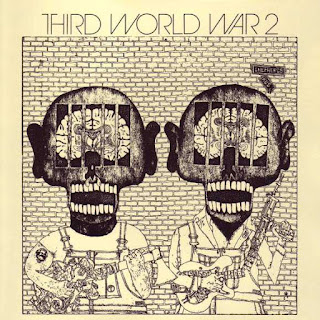
Third World War was conceived by the band’s manager, Jon Fenton, as a reaction to the hollow, yet fulsome hippy optimism that permeated rock and pop music at the time. Prefiguring Malcolm McLaren and the Sex Pistols (appropriately, John Lydon was a fan of TWW), Fenton assembled the band on this impetus, “manufacturing” the group to provide a voice for the realities of working class life in Britain. Fenton found and brought together the team of Jim Avery (bass) and Terry Stamp (rhythm guitar & vocals) - both certifiably young proletariat and aspiring songwriters - along with a rolling assortment of studio musicians.   This admixture would spew forth two albums worth of music that, although probably having too much of a swing and downright groove for most punk bands (even if sputtered with ultra-fuzzed guitars and some fantastically obnoxious musicianship), nevertheless had the requisite authenticity, directness of expression and anger of punk rock.  In fact, the two album cover designs used by the band for their records seem anachronistic entities, in that they could easily have been put out by Crass Records:


If the group’s creation was in anyway regarded by Fenton as a commercial concern, the ugliness and violence of the music created by Avery and Stamp would have quickly put paid to the illusion.  A salutary example of the band’s intransigently uncommercial nature is provided in the case of the song ‘Urban Rock’, which was chosen to be a single, lifted from the band’s second album (the excellently named ‘Third World War II’).  The album version’s lyric were clearly unviable for radio play, due to the narrator at one point extolling having “screwed a bottle in [a “fat thug’s”] face”, so a new version was recorded.  The group obliged with a single version that, if lyrically is more neutered, is if anything more violent due to the aggression of the band’s performance


If in ’77 much of the youth UK was ready to glut itself on anarchy and destruction, clearly, in the years TWW was active – ’70 to ’72 – the hippy dream still had a hold on people, and the band made little impression, quickly petering out due to not making any money.  They were seemingly much derided in the press – with one reviewer averring that they were the worst band in existence – and to this day they are largely forlorn and left out the story of rock music. Appropriately, one of the band’s songs ‘Stardom Road Part I & II’ is a self-aware lament for the impossibility of TWW ever reaching success:
That said, today they have a few famous vocal admirers, such as Paul Weller and Steve Albini, and can stake some claim to being, along with contemporaneous groups such as Crushed Butler and the Pink Fairies, sonically and spiritually kindred with the movement which was to come a few years later and change rock music forever.  More important than all this though, is TWW’s available recorded output which does not need to be contextualised in this matter for its greatness to become immediately apparent to anyone who loves soulful, strange and fucked-up music. 


For more information on Third World War visit the band’s official webpage:  http://www.stardomroad.com/Stardom_Road/Home.html

Terry Stamp, although forced to return to his previous job as a truck driver, continued to intermittently make music, which he does to this day.  Visit his website here:  http://www.gslmusic.com/


https://www.facebook.com/DarkandDirtySounds

By Mark Foley

Monday, 30 June 2014

Sleaford Mods - Divide and Exit

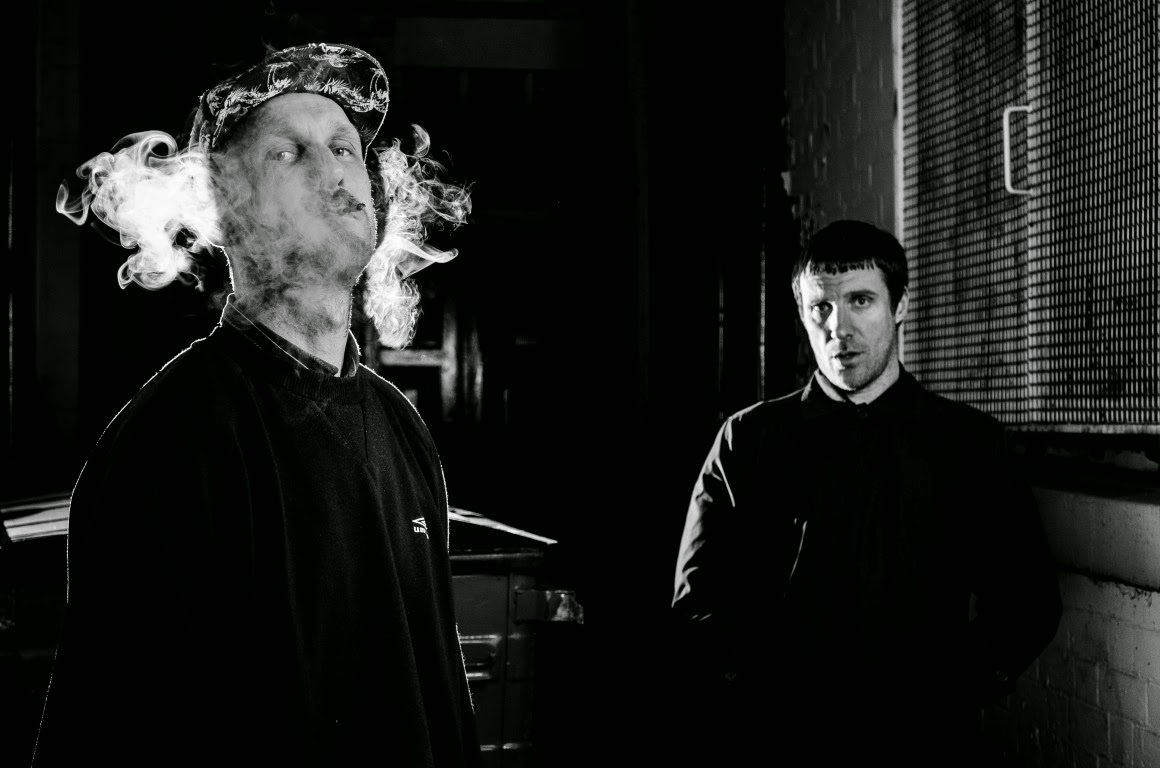
At times a band comes along who embody a sense of time and place and the state of society. Sleaford Mods are that band right now, and are either met with resonance or disdain. Those who write Sleaford Mods off after one listen are missing the point. They are arguably the most vital band around right now, they are shining a light on the piss-stained streets of austerity life that so many refuse to acknowledge.  They aren't wrapping it up in clever metaphors or masking it in intricate "musical landscapes".  They're living it and breathing it, they're calling out the bullshitters and  confronting them head on. 

Those who get it recognise the poetry in Jason Williamson's words, he fires off insightful lyrical volleys atop understated backing tracks from Andrew Fearne.  They aren't necessarily a political band - wit being the one constant at the heart of their songs - but the government is amongst many in Williamson's firing line. Others include pretentious snobs, Chumbawamba, "lonely little DJ's with no fucking life", rockers with "progressive side sleeve tattoos". Alex Turner and Miles Kane were recently berated on their social networking sites for dressing like "twats", and the designer Paul Smith  is ridiculed for finding "binspiration in everything" on 'Smithy' - essentially nobody is exempt.

The album begins with 'Air Conditioning' and a change of tact for the band with vocals rendered down in the mix.  Immediately after, the opening line on 'Tied up in Nottz' sets the tone for the remainder of the album, and has to be one of the best introductory lines I've heard: "The smell of piss is so strong it smells like decent bacon". 

On Tiswas he lambasts the state of Britain and the meaningless awarding of MBE's to people like David Cameron's hairdresser and Pete Tong: "Cameron's hairdresser got an MBE I said to my wife you better shoot me".  Album closer 'Tweet tweet tweet', highlights the gruesome and sad reality of modern life, where people are happy to film and tweet about "chopped heads on London streets".


This album displays progression in terms of sound since Austerity Dogs.  The band has gathered momentum lately having received critical acclaim, but I doubt they have aspirations of mainstream success. Their music depicts a twosome most at home in a sweaty club drinking warm cans of lager.  The music and profanity-ridden lyrical content is unlikely to see them selling out the O2 arena or win them an invite to the next Royal Variety show to perform alongside Michael Buble.  They will however most definitely be playing to more than "two dogs and an ash tray" (as Williamson once said).  Hard work has earned them the right to greater recognition and respect.   It's difficult to imagine in what way the band will evolve and who says they have to, they've got a simple formula, the lyrics are great, the tracks are catchy and it works so, WHO GIVES A...!

https://www.facebook.com/DarkandDirtySounds

Monday, 6 January 2014

Arcade Fire - Reflektor

2013 has wound to a close and it's always the time of year to reflect on albums that have captured the imagination over the last 12 months.  I haven't been updating D 'n' D Sounds as much as I would have liked, so here are a couple of standout albums I hadn't reviewed that are up there with my favourites of the year.

Arcade Fire - Reflektor

followed by,

Arctic Monkeys - AM


As a band Arcade Fire have displayed consistency and creativity throughout their career.  They have constantly attempted to stretch themselves artistically, never content to rest on their laurels and have subsequently become harder to pin down over time.

The media created controversy over the bands recent request for fans to turn up at shows in formal or costumed attire.  It was an attempt to engage the audience rather than a dictatorial stance. There is nothing wrong with trying to forge a bond between band and audience by producing, as they said: "A light-hearted carnival atmosphere at their shows."

The only criticism levelled at the album has been its considerable length.  There is no doubt it's a substantial double album but some double albums are worth the time. 

It's no easy feat to make an album sound light and upbeat whilst questioning their own existence, death and the afterlife, but Arcade Fire have managed it.  Album title track, Reflektor is one example when Win ponders: "If this is heaven, I don't know what it's for." On Here Comes the Night, it is playful to begin with before every instrument is played harder and faster and vocals are layered on top as Win proclaims: "But if there's no music up in heaven, then what's it for/When i hear the beat the spirit's on me like a live-wire/A thousand horses running wild in a city on fire."  It is an album highlight, it is catchy, it's poetic and like many songs on Reflekor a great dance track.  

Penultimate track Afterlife is another triumph, with it's insistent beat, thought-provoking lyrics and trademark Arcade Fire harmonies delivered with an air of desperation: "Afterlife, I think I saw what happens next/It was just a glimpse of you looking through a window/Or a shallow sea/Could you see me?."
On the other side of the spectrum you have a track like Normal Person which begins like Queens of the Stone Age's - If I had a Tail - before turning into an out and out heavy rock song

Bringing James Murphy in to produce the album was a masterstrokes, and one which has paid off.  Murphy's influence can be heard throughout with LCD-style beats infiltrating almost every song.  There was a chance Murphy's distinctive style could overpower Arcade Fire's own artistic endeavours. But when you begin to think it sounds too much like an LCD Soundsystem album the band's unique melodies, ghostly harmonies from Regine Chassagne or Win Butler's unique vocal style (which is played with a lot more on this album) will remind you that only one band sound like this right now.

Arcade Fire are one of the only bands on the planet who can seamlessly mix reggae with punk rock and dance and make it attractive.  They remain unpredictable and exciting, and that is refreshing in this overly-manufactured pop age in which we dwell.

By Garrett Hargan

https://www.facebook.com/DarkandDirtySounds


Arctic Monkeys - AM

Arctic Monkeys


Arctic Monkeys have been hard to match in terms of sheer sheer consistency since releasing Whatever People Say I am... back in 2006 when they were fresh-faced Sheffield scamps determined to follow in the footsteps of U.S. bands they admired such as The Strokes.

From the beginning they stood out from other indie contenders vying to be the British version of The Strokes.  The main reason being, Alex Turner's insightful observations about city-life as a teen/twenty something.  Fights in taxi queues, girls drinking wkd, trying to 'pull a bird'...

As a band their lives have changed dramatically since then, they now reside in L.A., have model/movie star girlfriends and I presume they don't have to worry about taxi queue brawls.  Their music has also experienced substantial transition.  In many ways they have out-stayed bands like The Strokes and Kings of Leon.  Their journey has been one of interesting progression whilst The Strokes have become lost in an 80's, synth-induced time-warp and KOL well, they've just lost it in entirely.

Whereas the first two albums were punchy and straight to the point, perhaps a reflection of the predominant subject matter of problematic nights on the town and pretentious behaviour.  The Josh Homme produced - Humbug signalled a change of pace and direction which the band have embraced on successive albums. 
Newest album AM has seen them slow it down further and suck the audience in with riffs as thick and smooth as treacle.  There is more emphasis on song structure and each track is given space to breathe. 

This pared-back approach is probably in part down to their new rock 'n' roll lifestyles in the LA sunshine and all the benefits that brings.  He sings of lust 'I Wanna Be Yours', late night booty calls 'Why's You Only Call Me When your High' and isolation and longing on 'Do I Wanna Know'.

It is an album of maturity, not necessarily a turning point because I believe the point of no return was reached during the making of 'Humbug'.  Some fans of the first two albums couldn't buy it but for those of us who enjoyed it, the journey has been a rewarding one ever since.  

They are now a band without boundaries, lets just hope they don't take it too far and disappear up their own colon - something which has been known to happen.  If they stay grounded, remember their roots and Alex considers dropping the Butlin's Redcoat act in between songs they'll have nothing to hold them back.  At the moment the music is doing all the talking for them as they continue to evolve and if that remains the case they could become one of the most memorable bands of their generation.


By Garrett Hargan

https://www.facebook.com/DarkandDirtySounds


Friday, 20 December 2013

Independents Plough their own Furrow – Castle Face Records Interview

We have a lot of crazy ideas but really I think what it comes down to is carving out our little part of the music-sphere, one killer record at a time, making sure that the art stays bangin' and the tunes keep clangin’, meet more artists and musicians, and just keep on doing our thing.”

– Matt Jones (Castle Face Records)

The glory days of independent record labels, for many, are a distant memory of a bygone era.  Major labels have monopolised the industry and continue to do so to a large extent.  But there has always been a place for small labels.  There is sometimes a romanticised notion of them; it is the struggle against the all too often insurmountable power of corporate behemoths.  But there is no mistaking the contribution independents have made to the record industry over the years.

These labels are usually run by like-minded individuals; where musicians, record company and fans come together in a bond of mutualism.  Therefore, current trends or aiming to please popular opinion is deemed irrelevant.  It is this single-mindedness and whole-hearted belief in what you are doing that allows creativity to flourish.  At times those forming the labels enter into it naively with little or no business experience, but a wealth of conviction.  This was well documented in the case of English labels like Rough Trade and Factory, which after a promising start and signing top acts, eventually imploded.  Rough Trade would return in 2000, with their marquee signings since then being The Strokes and The Libertines.

Over the years the origins of many music industry trends can be traced back to independent labels.  In the 1950’s American independent labels were responsible for developing a market for early rock ‘n’ roll and rhythm ‘n’ blues, prompting majors to follow suit.  In Britain punk was the catalyst that gave rise to many independent labels, including those mentioned above.  Artists and those involved in the scene at the time decided to adopt the D.I.Y. punk aesthetic, setting up their own labels to release the style of music, in which they believed.  The same attitude has led to the formation of many garage rock bands in the U.S. since the mid-2000’s, the most notable being; The Black Lips, Jay Reatard, Deerhunter, King Khan and the BBQ Show, as well as the Californian contingent in Ty Segall and John Dwyer, among others. 
Dwyer has been embedded in the San Francisco music scene for over a decade; he is currently founder and frontman of Thee Oh Sees, a band that is said to have started out as early as 1997, Dwyer experimenting with sounds by himself.  The band has seen a couple of line-up changes and released records consistently for the past 10 years, with the sound evolving over time, the one constant in it all being Dwyer.   His other bands include chaotic three-piece, Coachwhips, who delivered a ferocious style of noise-rock, with the type of memorably chaotic live show that would frighten promoters and venue owners alike.  Further back he has been in The Hospitals, Yikes and Zeigenbock Kopf to name a  few. 

He’s a man possessed, releasing an astounding amount of material, and along with others keeping the D.I.Y. approach alive.  In his spare time he’s an artist, and has actually created a lot of his own posters for shows.  Even Mark E. Smith, a prolific artist in his own right, who has released a record almost every year since The Fall’s inception, would struggle to keep pace.  Dwyer’s seemingly irrepressible creativity and work ethic has allowed him to release records year on year, sometimes several each year, as well featuring in various compilations. 

As if the man wasn’t busy enough this year he decided to set up his own record label – Castle Face Records – with friends Brian Lee Hughes and Matt Jones.  He is next in the line of musicians who have gone on to establish their own record label, but it isn’t a label financed by a multi-million pound recording artist, such as Jack White’s, Third Man Records.  This is a project on an altogether smaller scale, and therefore has to make the most of limited resources and has to carve out a niche in the market for itself.

It didn’t take long to discover the beating heart of their business and what makes the collaboration work.  When asked what type of brand they are trying to create, their ethos in terms of band selection, Matt said. “There are no real rules to what we will or won't put out.  John just told me last night that he listens to everything people send him at least once, which kinda blew me away.  That's a staggering amount of stuff.” It is a trait lost on corporate moguls, an honest, grounded attitude that can only be found in people with an unflinching determination to create and release music they love.  I decided to talk with Matt to find out more about the label and what makes it tick. 


First of all, how was the label formed, what is the background of each of the owners?

Firstly, Brian and John started up the label; I believe the way that it went down was that Brian worked on the Coachwhips film, of the final performance (which I was at and had forgotten about until years later) and a bunch of other footage of the band all put together, which was part of the Double Death release.  One way or another Brian fell in love with John's work as a musician and an artist and offered to help him finance a label to be able to put out his stuff, which coincided with an unnamed middle to large label dropping the ball on putting out “Sucks Blood”, so that was the first Castle Face release. I coincidentally was at a party around this time doing drugs and I met John, we hit it off, started talking about records (my day job is manufacturing vinyl with Pirates Press) and I offered to help John with getting the layout and production end of it together.  We became friends and I continued to work with them for a few years, one release at a time, and eventually they asked me to become their “third”.

I’m aware of John Dwyer and a fan, how did it materialise that he would be part-owner?

As I said above, he was the catalyst. I think we all realise that the label is as a result not only of John's style, drive, and astounding amount of love and support for what he digs, but also his desire to do things right; by the bands, and to be able to control his own stuff.  The label is really a result of his creative restlessness coinciding with his tireless advocacy for people whose work he's into. Frankly I'm honoured to be a part of it.

Is there an ethos behind the label, would you only sign a particular style of band, or what does the selection process entail?

Well as I’ve said, we wouldn't put out anything that John wasn't into.  It would defeat the purpose of the label and why people are paying attention to what we do.  Other than that, while there are common threads, there's no real rules to what we will or won't put out. John just told me last night that he listens to everything people send him at least once, which kinda blew me away.  That's a staggering amount of stuff.  That said, we have a bunch of great friends that are really talented and no shortage of stuff that we're already committed to doing or want to do or are pushing to do already...it would take a long time to get all the stuff done that we want to do right now...but typically it's John getting psyched on something and I help him figure out the brass tacks.

From my limited knowledge of independent labels, it seems as if it is often a labour of love, where money comes second to your passion for music, would you say that’s a fair assessment?  

Yes. There's not a ton of money in it even if you are successful. We've done a couple of good things but the fact of it is that it's been an insane amount of work and it's often pretty crazy how much time and brain drain I put into this...and it's certainly not paying my bills.

Does Castle Face finance recording as well as distribution of its own records?

No, not yet at least. We do pay for mastering, artwork and its attendant costs (like photo developing, etc), and manufacturing though.

What do you believe to be the main difference between major and independent labels?

Paperwork.

Is there someone within the label who designs the sleeves or is this left to each artist?

We work with a bunch of visual artists for the artwork on the releases.  John's done a few, we work with William Keihn a lot, Joe Roberts has done a few...Tim Presley did his own art for the White Fence record and it's fantastic.  David Shrigley did an awesome job with the Velvet Underground & Nico covers record.  It really depends on the release but I think people are kinda used to our “look” even though it's kinda varied.  Once we get the artwork, I do the layout stuff.  It's calming, I think.


I notice that you release limited edition coloured vinyl, as a record collector myself I think this keeps it interesting and brings out the inner child in a sense, that makes you want something new or different.  Do you think it is important to do this to keep the fans interest?  And is it something that makes independent labels unique?

Yeah, I've always loved coloured vinyl and since my day job is making vinyl it's kinda hard for me to get too stoked on black vinyl.  These days I keep all the coloured vinyl to our website, rather than selling it through distributors, so that there's a reason for people to buy them through us.  Frankly they need it as we're not exactly stellar at running a shipping business.  It often takes a while to get the orders out and it's always a bit chaotic, but it's a labour of love.

That said, major labels definitely do coloured vinyl, it's not just for us little guys...they definitely “get” that people are into it.  I'd say that smaller labels are certainly doing a lot more of the limited editions of stuff that people go nuts for though.  It makes sense if you're only able to afford to do 250 records to play up the limited availability of something.

And at the same time, I imagine this makes the printing process more expensive?  

Since I can speak from the manufacturing end of things, not really.  It's fairly inexpensive as far as custom stuff goes.  Gatefold jackets, now there's a hit to the bottom line...they cost about twice as much and can you reasonably charge that much more for a single LP just cause there's a gatefold? Good on ya if you do but I feel that it's harder to justify.  I kinda feel the same way about 180 gram but there's a time and a place for everything...

What has been the most satisfying aspect of working for the label?  

This is a great question. There's a million things that I love about the label, but I think what I like the most about it is that I feel like we're actually able to turn people on to something that they don't know yet and that we're excited about and that we've worked so hard to put in the best light possible.  I get to listen to stuff months sometimes before it comes out...I get to play with the track order, I get to make suggestions if I think something could work better one way or another...lay out the art, make decisions about what colours of vinyl and finishes for the jackets etc....and after all this push and pull where we're trying to key something in to the highest pitch, to make something as radical as we possibly can, it comes out and people actually give a shit.  We put it up on our site and they buy it, dig it, talk about it...It's insane and magical and I'm humbled and honoured to be a part of it.


Some of the garage bands seem to be breaking through these days, Thee Oh Sees are talked about a lot more in Europe along with Ty Segall.  Has any of this led on to commercial success for either the bands or label? 

The short answer is yes. They say a rising tide lifts all the boats, and it's certainly been the case here. Thee Oh Sees just got to the top of the CMJ charts (the college radio charts) and we didn't even have to bribe anyone! ha. (That's a joke). Ty's done great but I'd really put that squarely on his shoulders as the kid just don't know when to stop, he's constantly working and constantly coming up with great shit.  Have you heard Fuzz yet? It's killer. Both the bands are doing well and making money and maybe it says something about the state of our world that they're such the exception, but it's not easy to make a living off of this stuff and it seems as though they're both doing OK.

The label on the other hand, while technically making money, is a long way away from paying all of our bills. We're definitely breaking even and making a bit here and there but it's not an easy hustle. USPS just raised their rates and made shipping a ton more expensive, ESPECIALLY overseas.  We've grown so fast in the past year that we need to find a new place...we've been existing out of my office/warehouse with Pirates Press but it's gotten so out of hand that we're moving soon, so that's an added expense.  All that said, we've got so many killer releases coming up and more and more people keep hearing about us and wanting to check our stuff out that I think the momentum is going to pull us through...we don't put out anything we can't stand behind, there's no real reason to.  It's going to be a crazy labour of love every time we put anything out, so why muddy the pool with something that we're not crazy about?

Where do you hope to take the label in the future?

We have a lot of crazy ideas but really I think what it comes down to is carving out our little part of the music-sphere, one killer record at a time, making sure that the art stays bangin' and the tunes keep clangin', meet more artists and musicians, just keep on doing our thing.  We're moving into a new office, and as I mentioned we’re all really excited about that.  Getting the new space worked out and running smoothly will be a huge load off of my mind.  There's a part of your brain that goes “what if I could do everything right here?” and there's something appealing about having everything in one place at first, but for me, I just get disorganized and shit gets lost if I don't have established zones that are just for one thing.  So more zones. More drones. More tones.

And finally, do you think there will always be a place for independent record labels within the music industry? 

There will always be a place for innovative ideas when it comes to anything creative, so the agility with which individuals and small companies can pivot to people's tastes will always be more nimble than these established companies.  There's also seemingly a sea-change going on as to how much of a bureaucracy this industry can support as well, so low overhead will always be in fashion, in a way, and we may see significant changes to how the dinosaurs hunt. We'll see.  


By Garrett Hargan